Congregation and Family Life
Getting Involved in a Congregation
A practical path from Sunday visitor to volunteer: small first steps, ministry teams and the questions worth asking a pastor.
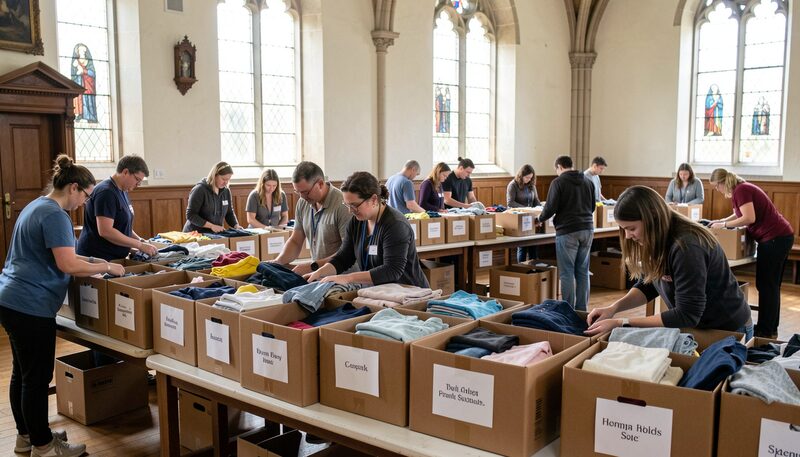
Between attending a congregation and belonging to one lies a stretch of ground that no signpost marks. The visitor has learned the folder, found the coffee hour, matched faces to names; the member sets up the tables. Crossing that ground is the subject of this article: the practical, unsentimental path from Sunday attendance to real involvement in a parish, written for people who want to belong to something in Macon but distrust the altar call version of the process. The steps are small, the timetable belongs to the newcomer, and none of them requires a personality change.
Why is the step from attending to belonging so wide?
Because congregations are communities with a liturgy for worship and none for joining. The service integrates a newcomer as an attender instantly; the community integrates slowly, through shared work and repeated presence. Sociologists of congregations describe belonging as growing through recognizable stages, from newcomer to regular to member to leader, and the transitions happen through activities rather than announcements. A congregation that publishes a New Member Sunday is inviting the paperwork; the actual belonging happens at the pancake supper. Knowing this spares the newcomer the misreading that a quiet congregation is a cold one. Rooms warm at the pace of the calendar, not of the welcome speech.
What is the smallest useful first step?
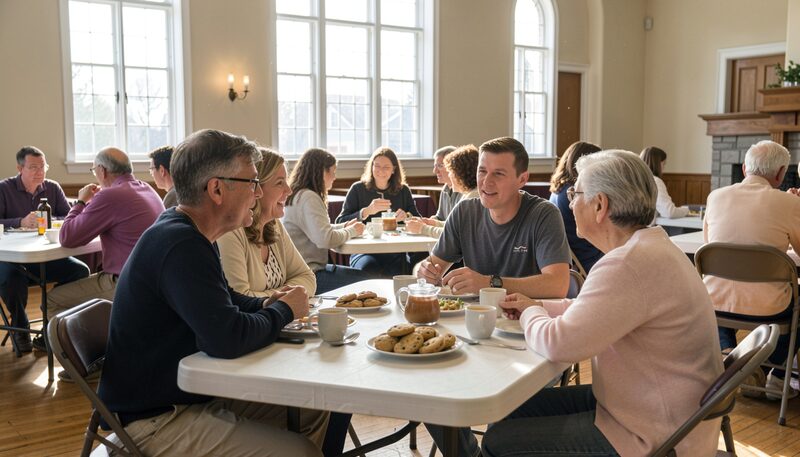
One event that is not a Sunday service. The soup supper, the work day, the choir's open rehearsal, the men's breakfast described in the article on adult education and small groups. The event should require a task, because tasks are the accelerant of acquaintance: people who shell peas together skip two months of small talk. Showing up twice matters more than showing up impressively once. Congregation schedules being what they are, the autumn and Lenten seasons supply a steady stream of such events, and a newcomer who attends one a month will be recognized by name before the holidays arrive without ever having filled out a card.
How does someone find a job in the congregation?
The jobs outnumber the applicants. Beyond the visible roles, choir and council and teaching, sits the invisible workforce: the folding and stuffing of bulletins on Thursday, the pantry pickup run described in the article on church food and clothing pantries, the altar guild linens, the grass, the collating of the newsletter, the casseroles. The reliable method is to name the constraint rather than the role: tell the office, or the pastor, the hours and the skills available, one weekday morning, a truck, an accountant's eye, a loud singing voice, and let the congregation do the matching. Congregations are chronically short of Wednesday morning hands and chronically polite about asking; the volunteer who self-identifies is rare and instantly deployed.
What are ministry teams and church councils?
The formal structure is a set of standing committees, often called ministry teams or boards: worship, education, property, outreach, finance, each with a chair and a roster. Above them sits the council or vestry or session, the elected leadership that meets monthly and holds the legal and budgetary reins, and above that the annual meeting of the whole membership, where budgets are voted and officers elected. In small congregations the council is eight people doing everything; in larger ones the teams have real rosters and real mandates. A new member serves a term on a team before being drafted onto the council, which is the congregational version of an apprenticeship. None of it requires prior experience; all of it requires showing up on the appointed Tuesday.
What conversation should a newcomer have with the pastor?
Every congregation makes this easy to arrange, and it is the highest-value hour a newcomer can spend in the building. The useful agenda is three questions: what does this congregation consider itself member-wise, meaning the expectations, the class or the transfer process if any; where is help actually needed, since the pastor keeps the master list of gaps; and how does giving work here, a subject the article on giving and stewardship covers from the congregation's side. The pastor, it should be said, has heard every version of just visiting and takes no offense at honest questions, including the version that begins with doubts. The office calendar settles the when in one phone call.
When does serving reach past the church walls?
Involvement inside the parish and service to the city are the same muscle worked at different angles, and Macon supplies the city side generously. The pantry shifts, the food bank warehouse, the river cleanups and the school reading programs described in the article on volunteering in Macon all run partly on church crews, and a congregation's outreach team is the usual door. The pattern cuts both ways: volunteers who arrive through the city project often end up in the pew, and members who tire of committee meetings revive in a pantry line. Serving neighbors is also the tradition's own theology of daily work, a point developed in the article on what Lutherans believe.
Is it all right to move on?
A quiet paragraph for the reader three years in and drifting. Congregational fit is real, seasons change, and moving on is ordinary rather than disloyal; pastors themselves say this, preferably before the awkward departure rather than after. The courteous method is a note rather than a disappearance, since small congregations worry about members who vanish. And the reader who has never quite landed anywhere in Macon should take the city's own variety as encouragement: the churches within fifteen minutes of Pierce Avenue span liturgies, languages and generations, and the article on a first visit to a church remains the correct instruction manual. The ground between attending and belonging is wide, but it is walkable in both directions.
Read next
Congregation and Family Life
Congregation and Family Life
Children and family ministries, first visits, adult study groups and the small steps that turn Sunday visitors into members.
Family ministries, first visits, study groups, and the path to belonging.

Congregation and Family Life
Children and Family Ministries
What church programs offer families: Sunday school, children's music, youth groups and seasons such as vacation Bible school.
Sunday school, children's music, youth groups and vacation Bible school.
Lutheran Faith and Worship
What Lutherans Believe
A plain introduction to Lutheran belief: grace alone, faith alone, scripture, baptism and holy communion in the Small Catechism.
Grace alone, faith alone, scripture alone, in plain words.