Outreach and Service in Macon
Giving and Stewardship
What stewardship means in a congregation: budgets, pledge seasons, transparent records and what ministry actually costs.

Talk of money makes church people shift in the pews, which is precisely why congregations that handle it openly stand out. Every parish in Macon runs on a budget, pays a light bill, supports a pastor or wishes it could, and sends a share of its income beyond its own walls; the money question is never whether but how. This article explains congregational giving as it actually works: the theology that frames it, the budgets it feeds, the pledge seasons that organize it, and the accountability that keeps it honest. It is written for members deciding what to give, and for outsiders curious what the plate actually buys.
What does stewardship mean in a congregation?
The word is older than the fundraising it now labels. In church usage, stewardship is the conviction that everything a person holds, income, hours, abilities, belongs ultimately to God, with the person acting as a caretaker rather than an owner. Giving follows from the belief rather than from an invoice: the question stewardship season asks is not how much the church needs but what portion of what has been received should return. That framing, which the article on what Lutherans believe places inside the wider Lutheran logic of grace and gratitude, is why congregations speak of proportionate giving, traditionally a tithe, a tenth, as a benchmark rather than a fee. A fee buys a service; a gift answers one.
Where does a small church's money go?
The typical congregational budget has three heavy lines. Staff costs, pastor's salary, housing and benefits, often insurance and a musician's stipend, absorb half to two-thirds of a small parish's income. Building costs, utilities, insurance, maintenance and the eternal roof, absorb most of the rest, since sanctuaries are large, old and expensive to heat. Mission and program spending, the pantry supplies, the curriculum, the youth trip, the denominational mission support described below, competes for the remainder. A congregation of a hundred giving households is functionally a small nonprofit with one fundraising event per week, which is exactly what the offering is.
What is mission support?
The line item that surprises outsiders: congregational giving that flows upward and outward. Congregations in most denominations forward a percentage of their undesignated income to their regional and national bodies, in the Evangelical Lutheran Church in America called mission support, which funds synod staff, new congregations, campus ministry, global mission partners and the denominational bureaucracy that keeps records. Members vote the percentage at the annual meeting, and the number becomes a public measure of the parish's outwardness. Alongside it sit designated causes, disaster relief, hunger appeals, the seminary fund, the quilt shipping costs mentioned in the article on adult education and small groups, which members designate directly.
What happens during pledge season?
Most congregations run an annual financial drive in the autumn, asking members to estimate next year's giving on a card, confidentially, so the council can write a budget grounded in arithmetic rather than hope. The season lasts a few weeks, carries a theme, and closes with the cards gathered and blessed. Estimating, not committing, is the operative verb; a pledge is a forecast that members adjust as the year changes. Congregational culture being what it is, the campaign's tone varies from a quiet letter to a full program of temple talks, and first-year members are never expected to pledge at all. The etiquette for visitors, stated plainly in the article on a first visit to a church, is that the plate passes and passes on.
How has digital giving changed the plate?
Thoroughly, and mostly to the good. Congregations now offer recurring online transfers, text-to-give numbers, QR codes printed in the folder, and app-based giving, and the recurring subscription has quietly become the budget's backbone, since summer attendance dips no longer equal income dips. The costs are real, processing fees of a few percent and the platform's annual fee, which finance teams weigh against the reliability; designated online gifts to the pantry, for instance, arrive with the fees already netted. The passing plate survives as ceremony, and cash in an envelope survives as anonymity, which remains a value the systems had to relearn to protect.
How does a congregation stay accountable?
The safeguards are standard across reputable parishes and worth knowing as a member. Counting is done by two unrelated people; deposits are reconciled by a third; the treasurer reports monthly to the council and annually to the whole membership at the annual meeting, where the budget is voted in the open. Larger congregations add a periodic financial review by an outside accountant. Giving records are kept confidentially by one officer, and members receive annual statements for tax purposes, since charitable contributions are deductible under American tax law. A member who asks to see the budget is asking a normal question, and the answer should be a spreadsheet, not a mood.
What about gifts beyond the weekly envelope?
The plate is the smallest tier of congregational finance. Above it sit memorial gifts given at a death, designated gifts for instruments and renovations, endowment funds where congregations invest principal and spend the earnings, and legacy bequests, which have quietly built more parish halls than any capital campaign. Property, appreciated stock and qualified charitable distributions from retirement accounts each carry tax treatments that make a conversation with the donor's accountant worthwhile. The congregations that benefit most treat these conversations as pastoral rather than transactional, which is also the correct description of the whole subject.
What does generous look like at any income?
The final word belongs to the tradition rather than the ledger. Stewardship's claim is that generosity is a practice before it is an amount, and that time, presence and skill are real lines in the same budget; the volunteering paths in the article on volunteering in Macon are the same doctrine wearing work gloves. A congregation's real wealth is measured in what it can reliably ask of its members, and Macon's congregations ask a great deal: the pantry shelf described in the article on church food and clothing pantries, the Sunday school teacher, the funeral casserole. The plate funds all of it, one envelope, one tap and one bequest at a time.
Stewardship covers what a congregation chooses to keep alive, and a budget line for children's ministry is one example. A church plot for children is not free: it needs tools, seeds, water, and adults who show up in July. The linked page follows that work through a Middle Georgia year, from what a garden needs to start to what a congregation gets out of it. Read ground kept for a garden as a companion to this page on giving and stewardship.
A church budget is a plan for ministry, and part of that plan is knowing what happens when a household's own budget runs short. Stewardship covers the pledge envelope and the line items it funds, but it also covers the moment a family cannot meet rent, food and utility bills and needs a starting point. That article walks through which bill has a deadline, what paperwork to bring, how congregations assist without running the program, and when to ask for a longer-term fix. It is a companion page to this one, written for the same Macon readers.
Read next
Outreach and Service in Macon
Outreach and Service in Macon
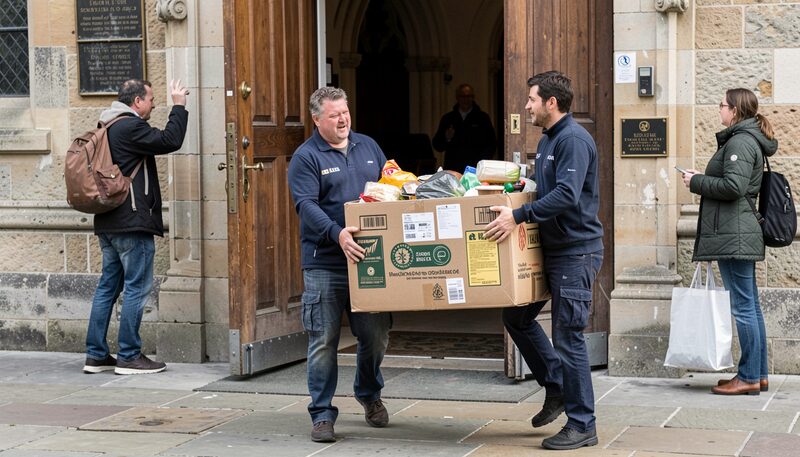
Food and clothing pantries, volunteering across Middle Georgia and the stewardship that pays for congregation outreach.
Pantries, volunteering and the money that funds congregation work.

Outreach and Service in Macon
Food and Clothing Pantries
How congregation pantries work: opening hours, eligibility, the donations that truly help and what a pantry week looks like.
How a pantry week runs, for users and for donors.
Lutheran Faith and Worship
What Lutherans Believe
A plain introduction to Lutheran belief: grace alone, faith alone, scripture, baptism and holy communion in the Small Catechism.
Grace alone, faith alone, scripture alone, in plain words.