Congregation and Family Life
Adult Education and Small Groups
Bible study, men's and women's groups, book circles and weekday classes: how adults keep learning inside a congregation.
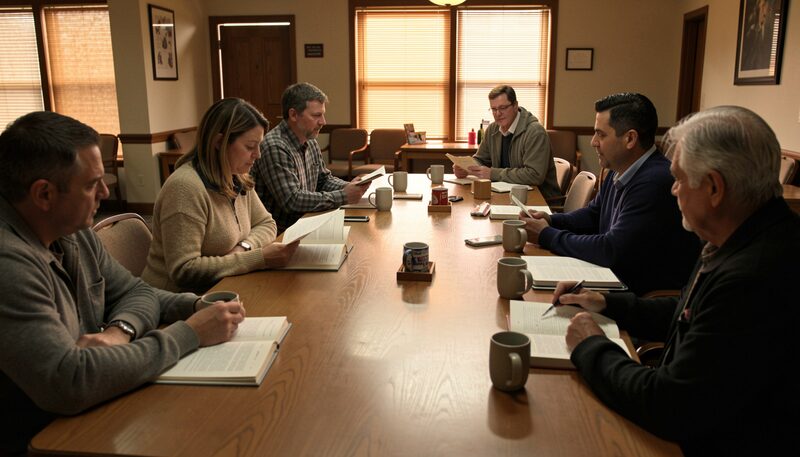
Sunday school is spoken of as a children's affair, but in most Macon congregations the adults outnumber the children in the classrooms. Adult education is the quiet infrastructure of a parish: the Sunday morning bible class between services, the Tuesday morning study that has met since the Reagan administration, the men's breakfast that fixes more of the church than the trustee meeting does. This article maps the adult learning life of an ordinary congregation, explains how each group works, and tells a newcomer how to step into one without ceremony.
What does the Sunday morning adult class study?
The standard format is a class between or after the morning services, taught by the pastor or a lay leader, running forty-five minutes with coffee. Content alternates between the lectionary, working the same readings the assembly heard in worship, and topical series: a book of the bible over a quarter, a church-history arc, or a season-shaped study for Advent and Lent. Attendance is come-and-go, since half the class travels for work or grandchildren, and regulars describe the format as graduate school with donuts. The class is the easiest adult program to join, because it meets when the visitor is already in the building; it is also where the congregation's actual theology gets argued out, one verse at a time.
How do weekday bible studies work?
Weekday studies meet mornings or evenings, in the parish library, a classroom or a member's dining room, and they run the congregation's emotional core. A typical group is five to twelve people, a leader with a curriculum or an open bible, and an hour that ends in prayer concerns, which is where the group learns who is in the hospital and who is not. Morning groups skew retired; evening groups skew working parents; both survive on the same three or four anchors who attend regardless. Studies usually pause for summer and restart after Labor Day. Visitors are welcome at every one of them without signing up, and the practice is uniform across the city: a call or an email to the church office produces the when and where, and the first visit produces a chair pulled to the table before the visitor has finished the doorway.
What do men's groups actually do?
The men's group is the most durable format in parish life, and the least pretentious. The pattern is a monthly breakfast, early on a Saturday, in the fellowship hall: eggs, business, a devotion, and a work list. The work list is the point; men's groups in Middle Georgia congregations end up maintaining the grounds, building the wheelchair ramp, delivering the pantry boxes and parking cars at funerals. Some groups add a study or a camp retreat, and Lutheran men's organizations have a long history of funding hunger and disaster work through denominational channels. A man new to a congregation joins by appearing at breakfast; the induction is a spatula.
What about women's circles and quilting?
Women's ministry in most congregations organizes as circles, small groups that meet monthly for study, business and mutual care, traditionally coordinating the funeral receptions and the altar guild. The quilting circle deserves its own sentence: in Lutheran congregations across the country, groups of sewers turn donated fabric into tied quilts shipped through Lutheran World Relief to refugee camps and disaster sites, tens of thousands of quilts a year, and the circle that meets Tuesdays around the frames is often the oldest continuous organization in the building. The pattern holds across denominations; Methodist and Presbyterian women's groups run parallel ministries with parallel histories. A newcomer who sews, or wants to learn, is recruited at the door of the quilt room by mid-morning.
What are book circles and seasonal studies?
Beyond the ongoing groups sit the temporary ones: the Lenten study that runs six weeks and dissolves at Easter, the book circle that reads one title a quarter, the parent-education short course, the personal-finance and marriage curricula that publishers ship to church groups by the pallet. Seasonal studies carry a social function as much as a learning one; a Lenten soup supper with a thirty-minute study is how congregations in Macon get through the gray weeks of February together. Topical curricula spark the room's arguments, which is not a defect; a class that finishes a marriage curriculum without an argument has not read the curriculum. The pattern for all of these is open registration through the church newsletter, and the only hard requirement is showing up.
How do small groups hold a congregation together?
The sociological fact underneath all these meetings is that congregations run on weak ties made strong by repetition. The class roster becomes the meal train when someone is diagnosed; the men's breakfast becomes the moving crew; the circle becomes the phone tree. Pastors name this the care network of the parish, and it is why membership in a congregation is measured in relationships rather than attendance counts. The article on getting involved in a congregation treats the same structure from the volunteer's side; here the point is the member's: join one group, any group, and the congregation's pastoral care system can find you.
What does a newcomer ask for?
The joining protocol is identical everywhere: ask the church office, or the pastor, what small groups are meeting this month, and say plainly which day of the week works. Every congregation keeps a list, published in its newsletter or announced in the bulletin, and every group on the list has learned to expect visitors. A useful second question is which group meets in the building, which is easier for a newcomer than navigating to a stranger's dining room in the dark. The magazine's own contact page explains how readers suggest subjects for articles like this one, and the article on congregation and family life places the small-group layer inside the fuller picture of a parish week.
Does adult education change anything?
The honest summary is that it changes people slowly and congregations eventually. A member who has worked through the tradition's core documents, and the doctrine behind them is sketched in the article on what Lutherans believe, argues better at council meetings and grieves better at funerals. A congregation whose adults keep studying keeps its youth teachers supplied and its pantry staffed, because teaching and serving draw from the same formed membership. Adult education is the parish's long game: the least photographed ministry in the building, and the one that supplies all the others.
Read next
Congregation and Family Life
Congregation and Family Life
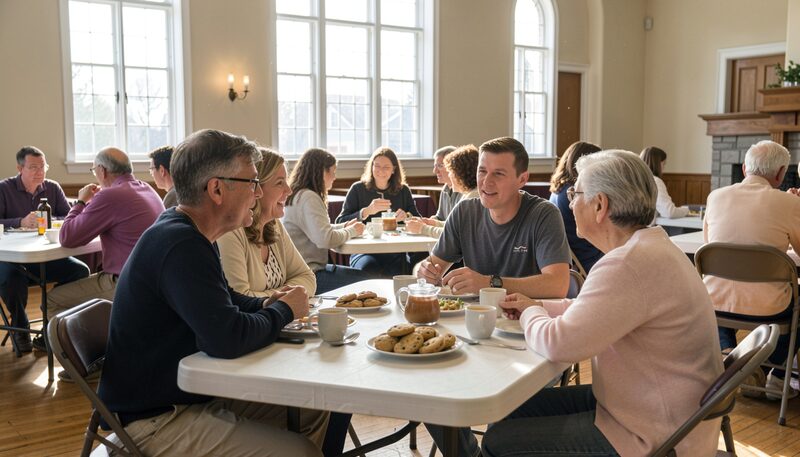
Children and family ministries, first visits, adult study groups and the small steps that turn Sunday visitors into members.
Family ministries, first visits, study groups, and the path to belonging.

Congregation and Family Life
Children and Family Ministries
What church programs offer families: Sunday school, children's music, youth groups and seasons such as vacation Bible school.
Sunday school, children's music, youth groups and vacation Bible school.
Lutheran Faith and Worship
What Lutherans Believe
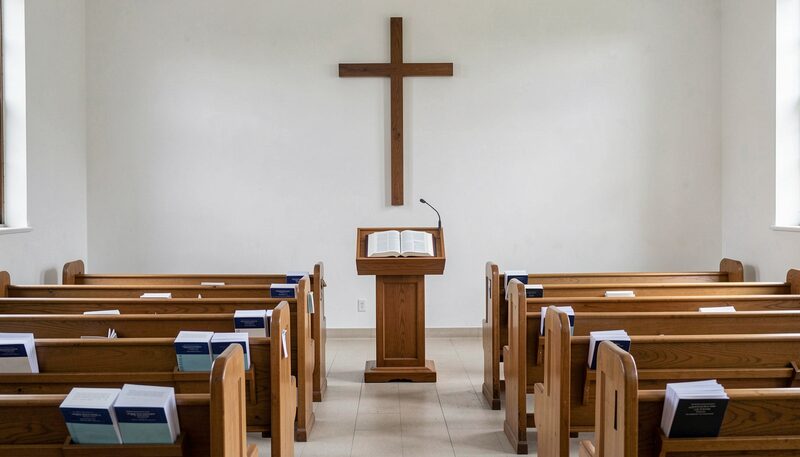
A plain introduction to Lutheran belief: grace alone, faith alone, scripture, baptism and holy communion in the Small Catechism.
Grace alone, faith alone, scripture alone, in plain words.